


UEFA Champions League Official
UEFA
I installed UEFA Champions League Official expecting a focused companion for European club football, and that is exactly where it makes the most sense. This is not trying to replace a general sports portal with every league and every sport in one place. It is an official, football-centered app from UEFA that brings match information, scores, goals, statistics, video, Fantasy Football, and Predictor games into one destination. I found it most useful when I wanted a quick answer about a Champions League match without sorting through unrelated headlines.
The app is free, rated for Everyone, and belongs to the Sports category. That combination makes it easy to recommend for families, casual viewers, and committed supporters alike. Its store presence is also substantial: it has passed 50 million installs, with an average rating of 4.8 from roughly 349 thousand ratings. Those figures do not automatically guarantee a perfect experience, but they do suggest that the app has become a familiar tool for a large football audience.
How the app feels when you need information quickly
My first impression was that the app is built around immediacy rather than long reading sessions. A supporter usually opens it with a specific purpose: checking whether a match has started, seeing a goal, reviewing a statistic, watching a clip, or making a Fantasy Football decision. The design supports that habit better than a traditional news app, where the important match detail may be buried below articles and opinion pieces.
The strongest speed advantage is not necessarily that every screen feels dramatically faster than every alternative. It is that the app keeps the Champions League context close at hand. I do not have to move through a broad football database before reaching the competition I care about. For someone following only UEFA club football, that narrower focus can feel quicker even when the underlying task is similar to what another sports app offers.
Live-score use is where expectations matter. During a quiet part of the day, opening a fixture and checking its information feels like a simple, low-effort action. During a busy match night, however, supporters may open the app repeatedly, jump between fixtures, watch video, inspect statistics, and return to Fantasy or Predictor sections. That is a more demanding pattern, and the experience depends not only on the phone but also on network conditions and the volume of activity around the competition.
Related News

Why WhatsApp Messenger Still Makes Everyday Communication Feel Easy

Jurassic World: The Game Is the Better Dino Tycoon for Strategic Players

Threads in Real Life: Who Should Join, Lurk, or Leave

How SHEIN Turned Shopping Into an Endless Content Feed

How to Make Fortnite Feel Smarter on Mobile

Should You Switch to Microsoft Outlook on Mobile?
I would not choose this app solely because I expect it to be the fastest possible tool for every score in world football. A dedicated live-score service with extremely broad coverage may be more convenient for someone tracking several domestic leagues at once. UEFA Champions League Official is faster in a different sense: it reduces the distance between the user and official competition-focused information.
What I use it for before, during, and after a match
Before a match, I use the app as a preparation screen. It is useful for checking the fixture context, looking over available statistics, and deciding whether I want to follow the game through live updates or video. This is also the point where the Fantasy Football and Predictor areas become relevant. They give the app a reason to stay installed between matchdays instead of becoming something I open only when a game is already underway.
During a match, the practical workflow is simple: open the relevant fixture, check the score and key event information, then move to statistics or video when I want more detail. I like this separation because it avoids forcing every user into a fantasy or social experience. If I only want the score, I can treat the app as a match monitor. If I want deeper involvement, I can spend more time with the interactive sections.
Gallery
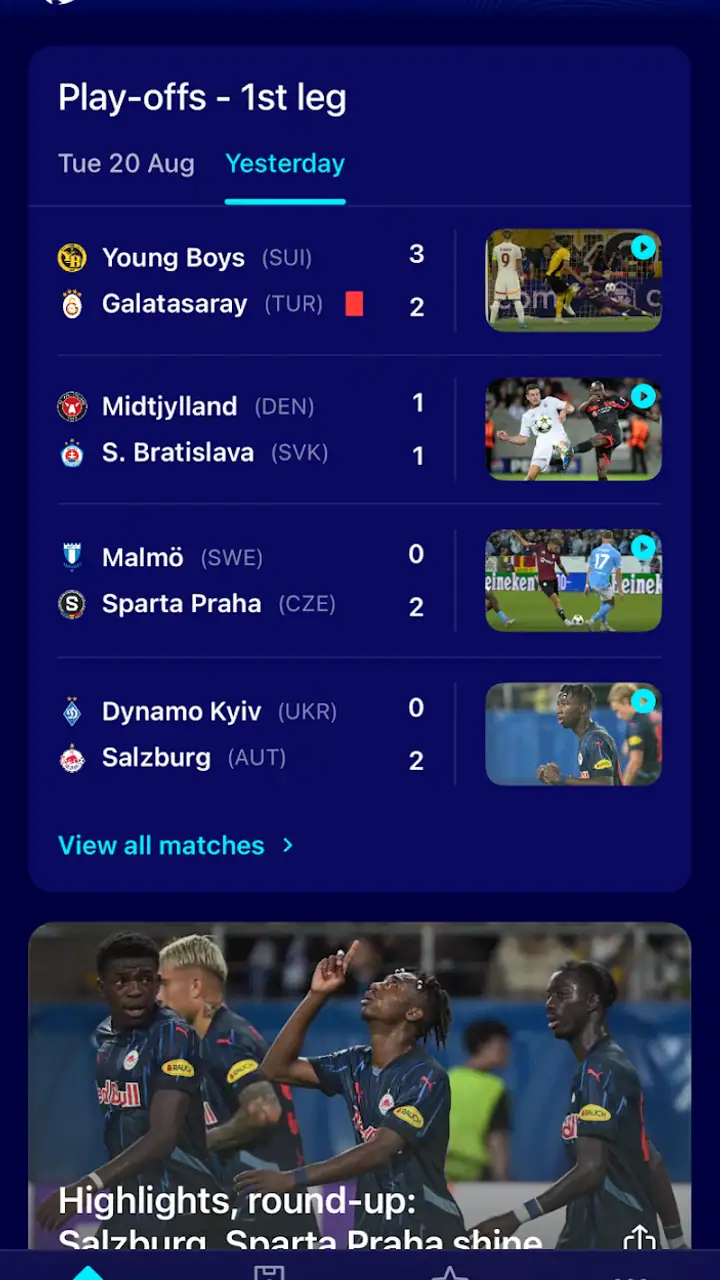
After the final whistle, the statistics become more valuable than the live score itself. A result tells me what happened; match information and numbers help me understand the shape of the game. This is especially useful when I missed the broadcast and want a compact way to catch up. The app works well as a bridge between “Who won?” and “How did the match develop?”
One useful habit is to decide what I need before opening it. If I am checking a single result, I avoid wandering through video and game sections. If I am preparing a Fantasy team, I give myself more time and treat the app as a planning tool rather than a quick notification panel. That small distinction keeps the experience efficient and prevents a short check from becoming an unfocused browsing session.
Heavy-use moments reveal the real trade-offs
The most revealing test for any football app is a major match window. That is when many people want the same information at once, and when a user is more likely to refresh, change screens, and compare several fixtures. In my experience, the app’s appeal during these moments comes from its official competition focus, but the interface can feel busier when I ask it to do several jobs in quick succession.
Live scores, video, statistics, Fantasy Football, and Predictor games serve different types of attention. A score screen should be glanceable, while a fantasy section invites analysis and a video area encourages browsing. Moving between them can make the app feel less like one single-purpose tool and more like a small Champions League hub. That breadth is valuable, but it also means the cleanest experience comes when I use one section at a time.
For a realistic everyday scenario, imagine checking a match while commuting. I might open the app to see whether the score has changed, read the latest event, and close it again before reaching my stop. That is a good use case because the app’s official focus gives me a direct route to the competition. If I then decide to watch video or examine several statistical views on a weak connection, the same journey becomes less predictable and less comfortable.
Another scenario is a group of friends preparing a Predictor entry before a match. The app is more engaging here than a plain score tracker because it gives the football conversation somewhere to go. We can move from the fixture itself to predictions and then return later to see the outcome. The trade-off is that a user who wants only an ultra-light score utility may find these extra areas unnecessary.
I also pay attention to recovery after interruptions. Phones receive calls, switch networks, lock their screens, and reclaim memory from background apps. When I return to a sports app after one of those interruptions, I want to get back to the match rather than reconstruct my route. UEFA Champions League Official is best approached as a current-session companion: reopen the relevant competition or fixture and continue from there, rather than assuming it should replace a dedicated notification system.
Stability and trust during a live competition
The developer is UEFA, and that matters to me because the app’s purpose is tied directly to the organization behind the competition. I am more comfortable using it for Champions League context than relying on an unofficial app whose main value may come from repackaging information. The official identity does not remove every possible technical annoyance, but it gives the product a clear editorial center.
The app has been available since August 12, 2015, and its current version is 17.0.1. I see that long presence as a practical sign that this is an established product rather than a short-lived match companion. It also helps explain why the app covers more than basic scores. Over time, the experience has room for match information, video, fantasy participation, and prediction-based engagement within the same football ecosystem.
Reliability is not only about whether the app opens. It is also about whether the information remains understandable when I return at different points in a match. A clear fixture structure helps me avoid confusing a preview with a result or a live event with a post-match detail. I appreciate that the app’s purpose is narrow enough to make that hierarchy meaningful.
Still, I would keep reasonable expectations during the most intense football moments. No app should be treated as the only source of information if the match is important to me and my connection is unstable. I would use this app for the official competition view, but I would not build an elaborate personal workflow that depends on one screen remaining available every second. That is not a criticism unique to UEFA; it is a sensible approach to any live sports service.
Video is another area where reliability depends heavily on circumstances. It can add much more value than a plain score, especially when I want to see the key moments or catch up visually. At the same time, video naturally asks more from a connection and a device than a text-based match update. I treat it as an optional layer rather than something that should be running continuously while I perform other tasks.
Phone limits, storage habits, and battery expectations
The minimum operating-system requirement is Android 7.0, which makes the app accessible to a wide range of Android phones. That does not mean every compatible device will feel identical. A newer phone with a stronger processor and more available memory should handle rapid switching between match details, statistics, video, and interactive sections more comfortably than an older entry-level model.
On a modest device, I would keep the workflow focused. Open the fixture, read what I need, and close sections that are not relevant. The app becomes more demanding when I combine live updates with video and repeated navigation. If my phone already struggles with other sports, news, or streaming apps, I would not expect this one to behave like a lightweight calculator simply because its main subject is football.
Storage is worth considering in a practical way. A sports app can be useful without becoming a permanent media library, but video-oriented browsing may encourage longer sessions than a score check. I would avoid leaving many unrelated apps active during a major match if my phone has limited memory. That is a simple recovery tip: reducing background pressure can make it easier to return to the match after switching away.
Battery expectations should also match the task. Reading scores and statistics is a relatively restrained activity compared with watching video, refreshing frequently, and keeping the screen bright for a long period. If I am following a full match through the phone, I would use the same common-sense habits I apply to any sports or video app: lower unnecessary brightness, avoid constant manual refreshing, and save video for the moments when it adds real value.
Someone using an older Android phone should not automatically skip the app. The minimum requirement is accommodating, and the core score-and-information workflow is likely to be the most practical place to start. I would become more cautious only if the phone has very limited free space, weak battery health, or a history of closing apps whenever I multitask.
Where it beats ordinary sports alternatives
Compared with a general sports app, UEFA Champions League Official wins through focus and authority. A broad service may cover more competitions, offer more customizable score feeds, or provide a stronger all-sports overview. That is the better choice for a user who follows football across many countries and wants one universal dashboard. I would choose UEFA’s app when the Champions League itself is the center of my attention.
Compared with a general news app, it is better for match intent. News apps are useful for interviews, analysis, transfer stories, and wider context, but they can make a live score feel like one item among hundreds. This app keeps the competition experience together, including the more playful Fantasy Football and Predictor elements. The compromise is that it is not my first choice for broad football journalism.
Compared with a dedicated live-score tool, the difference is depth versus coverage. A specialist score app may be better if I need simultaneous tracking across numerous leagues, lower-friction alerts, or an extremely compact list of fixtures. UEFA Champions League Official gives me a more complete competition environment, with official video and interactive features alongside match information. I would not call one universally superior; the right choice depends on whether I value breadth or a concentrated tournament experience.
The app also has a different relationship with fantasy products. A standalone fantasy platform may offer a deeper fantasy-first workflow, while this app lets Fantasy Football sit beside scores, video, and competition information. That is convenient for casual players and supporters who want one place to check everything. Serious fantasy managers may still prefer a dedicated tool if they want their entire routine organized around transfers, planning, and long-term management.
Who will enjoy it, and who should look elsewhere
I recommend it most strongly to Champions League supporters who want an official starting point on matchdays. It is also a good fit for people who enjoy turning passive viewing into participation through Fantasy Football or Predictor games. Families can use it together because the content rating is Everyone, and the free price removes the usual barrier to trying it before deciding whether it deserves a permanent place on the phone.
It is less suitable for someone who wants one app to cover every sport, every football division, and every local competition. It may also disappoint users who measure a sports app only by the speed of a minimal score list. The official competition focus is its main strength, but that same focus means it is not designed as a universal replacement for every sports service.
I would also hesitate to recommend it as the only tool for users with very limited data or an older phone that already struggles with media-heavy apps. The core information is the sensible entry point, while video and repeated live browsing require more patience and resources. In that situation, a lighter score service may be a better everyday companion, with this app kept for official match context and competition features.
For new users, my advice is to spend a few minutes exploring the main areas before a big match begins. Find the route to live match information, then look at where video, Fantasy Football, and Predictor games sit. Doing this ahead of time avoids learning the layout while emotions are high and the score is changing. It also helps you decide whether you want a quick-check workflow or a longer interactive session.
My performance verdict after regular use
UEFA Champions League Official feels strongest when I use it as a focused, official match companion rather than an all-purpose sports replacement. Its speed comes from concentration: the app puts the competition I care about ahead of unrelated content. Its stability benefits from being an established UEFA product, while its heavier moments come when I combine live match browsing, statistics, video, and games in one session.
I like the balance between practical information and engagement. I can open it for a score and leave quickly, or stay longer to explore video, Fantasy Football, and Predictor games. That flexibility gives the app more lasting value than a basic fixture list. The main limitation is that the broader experience can feel less lightweight than a dedicated score utility, particularly on older phones or weaker connections.
With its free access, Everyone rating, Android compatibility from version 7.0 onward, and a current version of 17.0.1, it is easy to try without making a major commitment. Its strong average rating and large install base reinforce the impression that it serves a real audience well, although my recommendation still depends on what you expect from a sports app.
My final recommendation is simple: install it if the UEFA Champions League is the competition you follow most closely and you want scores, statistics, video, and prediction-style participation in one official place. Choose a broader live-score or news alternative if your attention is spread across many leagues or if your priority is the lightest possible score-checking experience. For the right supporter, this is a dependable football hub; for everyone else, its narrow focus is precisely the reason to compare it with something broader before making it your main sports app.
FAQs for UEFA Champions League Official
What features does the UEFA Champions League Official app offer?
The UEFA Champions League Official app provides live match coverage, including real-time commentary, highlights, and goal notifications. Users can access the latest news, exclusive interviews, and in-depth analyses of matches. Additionally, it offers personalized content, such as tailored notifications for your favorite teams and a detailed calendar of upcoming fixtures.
Is the UEFA Champions League Official app free to download and use?
Yes, the UEFA Champions League Official app is free to download on both Android and iOS platforms. However, some features may require a stable internet connection, and there might be in-app advertisements. Occasionally, premium content or features may be available for purchase, but the core functionalities are free.
How can I personalize my experience on the UEFA Champions League Official app?
Users can personalize their experience by selecting their favorite teams and players. This customization allows the app to send tailored notifications about match events, news, and highlights specific to your interests. You can also adjust the type of push notifications you receive to stay updated on the information that matters most to you.
Does the app provide live streaming of matches?
The UEFA Champions League Official app does not offer live streaming of matches. However, it provides extensive live coverage with real-time statistics, play-by-play commentary, and video highlights. For live streaming, users must check local broadcasting rights or official streaming partners associated with UEFA.
Is the UEFA Champions League Official app available in multiple languages?
Yes, the app supports multiple languages to cater to a global audience. Users can choose their preferred language in the app settings, ensuring that they receive content, news, and updates in a language they are comfortable with. This feature enhances accessibility and user experience across different regions.
Pros
- Comprehensive match coverage.
- Live scores and notifications.
- Exclusive video highlights.
- Detailed team and player stats.
- User-friendly interface.
Cons
- Requires stable internet connection.
- Ads can be intrusive at times.
- Limited customization options.
- Occasional app crashes reported.
- Some features need premium access.


